Edison, NJ · Garage Door Service
Garage door repair for Somerville, NJ homes built mostly in 1958 - steel panel doors, extension springs, and cold-climate track wear. Serviced from Edison, 11 miles out.
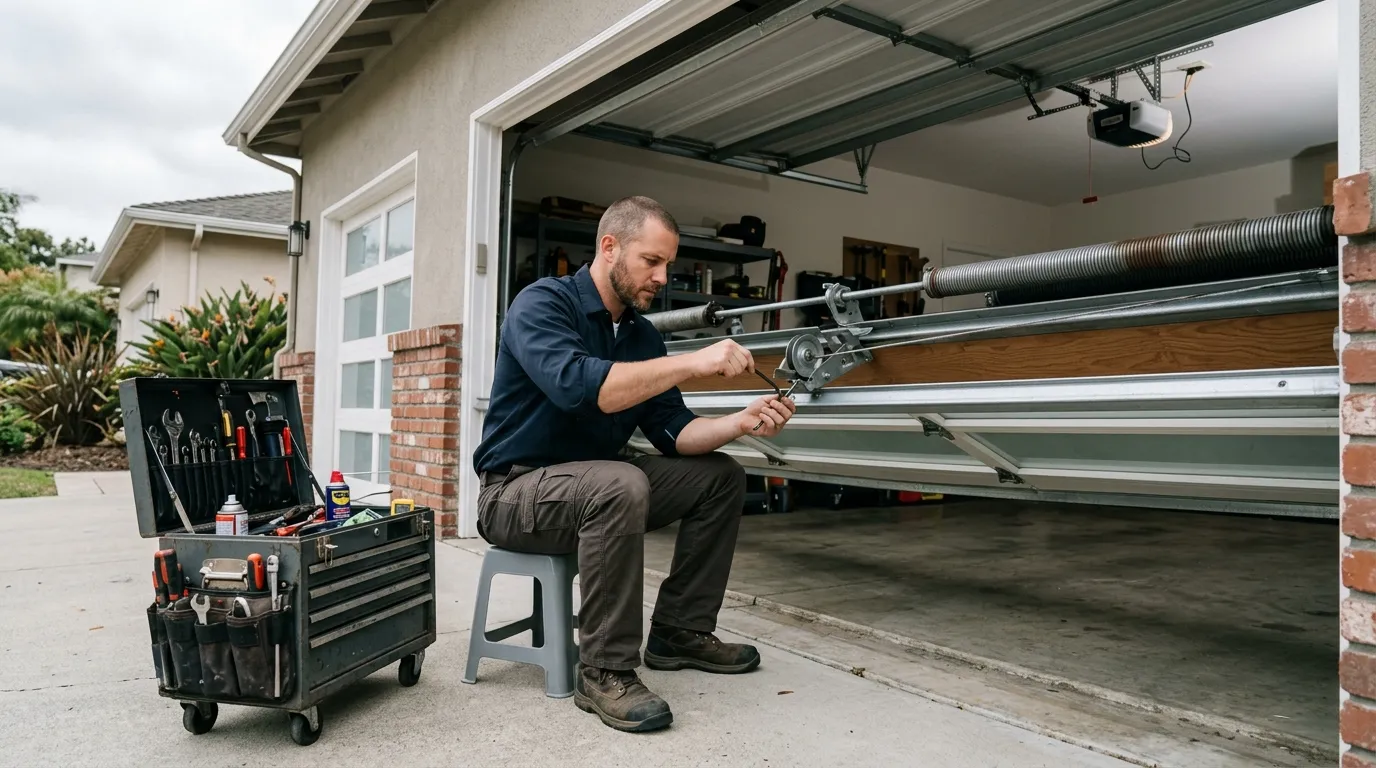
Most houses in Somerville went up around 1958, which puts the town in the middle of the postwar building push rather than the older prewar streets you find elsewhere in the wider Edison service area (that area runs 1938 to 2001, median 1963). A 1958 build usually means a steel raised-panel door hung on extension springs with side pulleys, not the torsion setup you'd find on anything built after the mid-1980s. Track is often the original jamb-mounted style, bolted straight into wood framing that has moved a little every winter for over sixty years. The failure we see most in this housing is a snapped extension spring cable or a pulley that's worn oval instead of round - the door drops crooked on one side before it drops all the way. Cold-climate freeze-thaw (this whole corridor sits in a severe cold band) works the bolts loose in that older wood jamb faster than it does in newer construction with steel jambs. None of this is exotic work, but it's not the same job as fixing a torsion spring on a 2005 build, and a shop that only knows the newer hardware will spend time guessing.
We run out of Edison, and Somerville is about 11 miles from that shop - not next door, and we're not going to pretend otherwise. There's no depot here, no truck parked around the corner. We schedule Somerville jobs into the route for that side of the coverage area rather than treating it as a drop-in stop, which is the honest way to say it: if you call, we're driving to you, not walking. We don't have a guaranteed same-day window we can put in writing, and anyone who tells you a fixed response time before they've seen the job or checked the route that day is guessing. What we can tell you is we plan for the distance instead of ignoring it, and we'd rather say that up front than promise something we'd have to walk back later. If a spring goes in the morning, tell us when you call - it changes where you land in the day's route.
Our coverage out of Edison runs through a set of towns at increasing distance from the shop, and Somerville sits toward the outer edge of that range rather than the middle. We treat Bound Brook and Watchung - both close by - as the practical boundary of the routes we run day to day; past that ring, the drive starts costing more than the job. That's not a judgment on the towns further out, it's just arithmetic about a truck and a schedule. Inside that boundary, Somerville gets the same crew and the same parts stock as anywhere closer to Edison. We're not going to claim a local presence we don't have, and we're not going to quietly stretch the map further than we actually drive. If you're near the edge of that ring and you're not sure whether we cover your street, ask when you call - it's a quick answer, not a maybe.
Somerville has roughly 5,604 households, small enough that most of the housing stock reads as one generation rather than several. The median build year of 1958 lines up with the middle of the region's broader 1938-2001 range, but it skews earlier than a lot of what's gone up nearby since. Median household income here runs $103,869, noticeably below the $124,065 median across the full service area, which tends to show up in the calls we get - more requests to repair a working-but-tired door and fewer requests to swap the whole unit for something new. The severe cold-climate band this area sits in matters more here than in newer construction: original steel doors from the late 1950s don't have the foam-core insulation that later doors got as standard, so temperature swings hit the panel and the seals harder. None of that means the doors are failing wholesale - it means the common fixes lean toward hardware and weatherproofing rather than full replacement, and that's usually the cheaper call anyway.
No. We work out of Edison, about 11 miles away, and schedule Somerville jobs into our route rather than staffing a local depot. You'll get the same crew and parts stock as any other stop on that route - we just don't have a shop on your street.
On houses built near 1958, the original extension spring pulleys wear out together because they've carried the same weight for the same number of years. When one side goes, the other is usually close behind. Replacing both at once is the more sensible repair, even though only one has failed so far.
Depends on the door. If the panels are sound and it's a spring, cable, or track issue, repair usually makes more sense for a 1950s-era door than full replacement. We'll tell you honestly if a repair isn't worth doing - sometimes the frame or panel damage means replacement is the cheaper path long term.
This area sits in a severe cold climate band, and doors from the late 1950s often lack the foam insulation later doors have as standard. Weatherstripping and seal replacement matter more here than on newer builds - it's a smaller job than people expect and it cuts down on drafts through the panel gaps.
Call now or request a free quote - same-day service on most repairs, upfront written pricing.